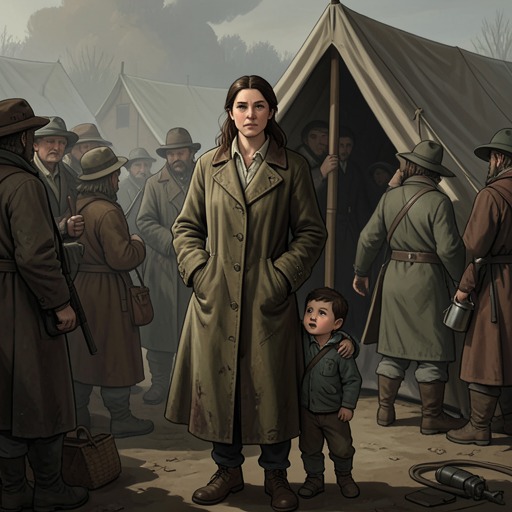
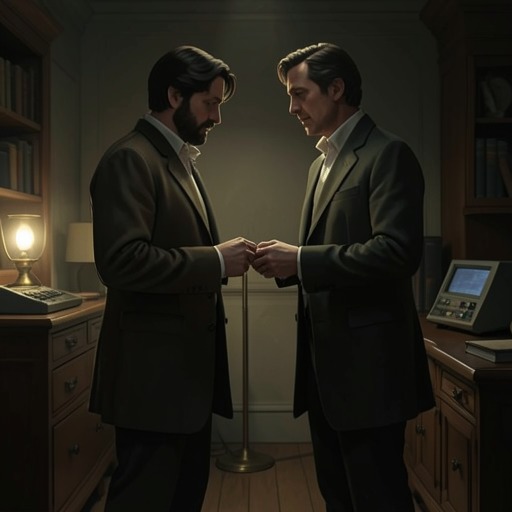
Delphine discovers Cyprian with another man
The Master Butchers Singing ClubDelphine discovers Cyprian with another man during a solitary walk to a riverbank, a chance encounter that makes visible what he had not told her. The discovery unsettles her expectation that their mutual closeness might become conventional romantic love, but it does not simply dissolve their connection. Instead, it leads to an intimate conversation about Cyprian’s desire, the limits of their partnership, and the forms of understanding and care that remain possible between them.
The Riverbank Discovery
Two days after an intense but unrepeatable moment of intimacy between them, Delphine went alone to the river. Cyprian had left after their performance without telling her where he was going. She did not spend the evening brooding over his absence: she sat on a low bench and watched the northbound current. When other people approached, she slipped into the brush, hoping to keep the bench to herself and avoid conversation.
Two men entered the clearing. One sat on the bench while the other knelt before him. Hidden nearby, Delphine initially could not make out what was happening. She heard one man speak and saw the pair change positions, but did not understand the encounter all at once. As she watched, she recognized Cyprian by his bright white shirt. The recognition brought shock and curiosity together; she stayed concealed long enough to understand what she was seeing, then surprised herself by stepping out of the brush and greeting them cheerfully.
The men hurried apart. Delphine sat down, lit a cigarette, and made polite conversation, steering the exchange toward neutral topics rather than naming the encounter. Her composure had an almost dreamlike, amused quality, even as her thoughts worked on several levels at once. The three talked as they walked away from the river, and the other man and Cyprian parted separately. Delphine and Cyprian then walked back to their room together.
An Unspoken Night and a Question
On the way back, Delphine entertained the hope that, now the encounter had been exposed, she and Cyprian might at last become true lovers. She also knew that this hope might be naïve. At the room, neither of them raised the subject. They undressed, got under the covers, and held hands in silence, alert and lost in the aftermath of what had happened.
Later that night, Delphine woke Cyprian. She had intended to challenge him about what she understood as betrayal, and to ask why he had never told her about his desire for men. But when she spoke, the question that emerged was practical and sincere: “How do you balance?” Cyprian had never put the experience into words before. In the darkness, with Delphine aware of his secret and not speaking in anger, he tried to explain. When she asked what happened when he fell, he described the need to forget that he existed and strike the ground weightless, “as a shadow strikes the ground.” Delphine answered that she thought she would leave him; Cyprian asked her not to.
Their talk did not settle the future of their partnership, but it established a new kind of candor between them. The riverbank encounter had brought Cyprian’s concealed life into Delphine’s knowledge; the ensuing question allowed him to speak about an essential part of himself in terms other than shame or accusation. Her curiosity did not erase the hurt or uncertainty, yet it became the means by which they continued to address one another.
Naming Desire and Reframing Their Bond
The question returned after the deaths of three people in the cellar of Delphine’s father, Roy Watzka. In the exhaustion that followed, Delphine and Cyprian sat beside a fire. She brought up “that man by the river,” making clear that she meant the encounter she had witnessed. Cyprian replied that Delphine was all he wanted out of life. For her, this carried the promise of devotion, and perhaps marriage; at the same time, she now understood that his desire for men placed a limit on the kind of romantic future she had once imagined.
Delphine asked why he did it, and insisted that she needed to know. Cyprian first tried to locate the cause in the war. He considered whether wartime closeness with men, gas, septic wounds, trench illness, or fear might have changed him. But he recognized that these explanations could not account for his experience. During the war, he had been deeply in love with a man whose death he still grieved, and he had known long before that his feelings for men were not new. The war had brought other harms; it had not created the desire he was trying to explain.
Cyprian asked Delphine to consider her own desire for men and suggested that his answer was the same as hers. After thinking it over, she felt a kinship with him that she described as more female than male: she believed she could tell him what was in her heart and that he would understand because he had felt its truth himself. She accepted the answer, though it meant acknowledging that they would not be lovers in the way she had once hoped. Their future as traveling performers was also uncertain, and their immediate circumstances required them to find work.
A Partnership Beyond the Expected Romance
The discovery therefore changes the terms under which Delphine understands Cyprian without reducing him to the encounter or making their affection false. Earlier, Delphine had imagined that their shared intensity might open into conventional romance. After the riverbank scene, she learns that Cyprian’s intimate life cannot be reconciled with that expectation simply by keeping it secret. The conversation that follows gives her a more complicated understanding: their closeness is real, but it does not make them a conventional couple.
Their later life continues to show the practical and emotional weight of this bond. In the crisis following the discovery of three bodies in Roy’s cellar, Cyprian makes a separate shelter for Delphine’s father near the river and away from the main tent, while Delphine and Cyprian endure the aftermath together. In another difficult period, Delphine develops a routine to help Markus become dry in the mornings, and Cyprian understands the purpose of her plan and agrees to help. These are not resolutions of the riverbank scene; they show how the partnership endures through protection, work, and shared responsibility rather than a promised marriage.
The episode’s decisive shift is from unspoken expectation to an acknowledged difference. Delphine does not stop caring for Cyprian, and Cyprian’s love for her is not presented as a disguise for his desire. Their relationship makes room for attachment and care without pretending that these must take the form of sexual exclusivity or conventional romance. Delphine’s discovery is painful and disorienting, but it also becomes the beginning of a more truthful understanding of the person beside her.